 $cd ~
$cd ~Operating System Concept: CPU Scheduling
Background
One of the purposes of an OS is to run multiple programs for users with a limited number of processors. We also want to maximize CPU productivity under different kinds of use cases.
CPU burst and IO burst
A CPU burst is a period where a program executes computation instructions. An IO burst is a period where execution waits for an IO request to complete.
If a program tends to have longer CPU bursts, we call it CPU-bound. Otherwise, we call it IO-bound.
The general histogram of CPU burst:
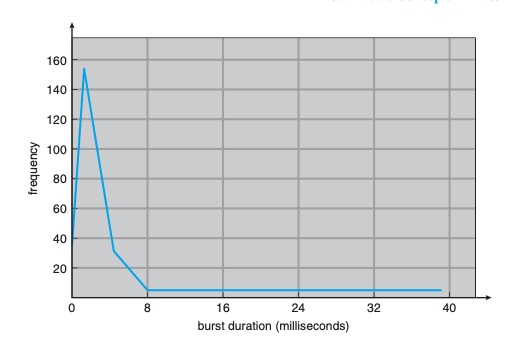
This distribution is important when selecting a scheduling algorithm. Typically, IO-bound tasks have many short CPU bursts, while CPU-bound tasks have fewer but longer CPU bursts.
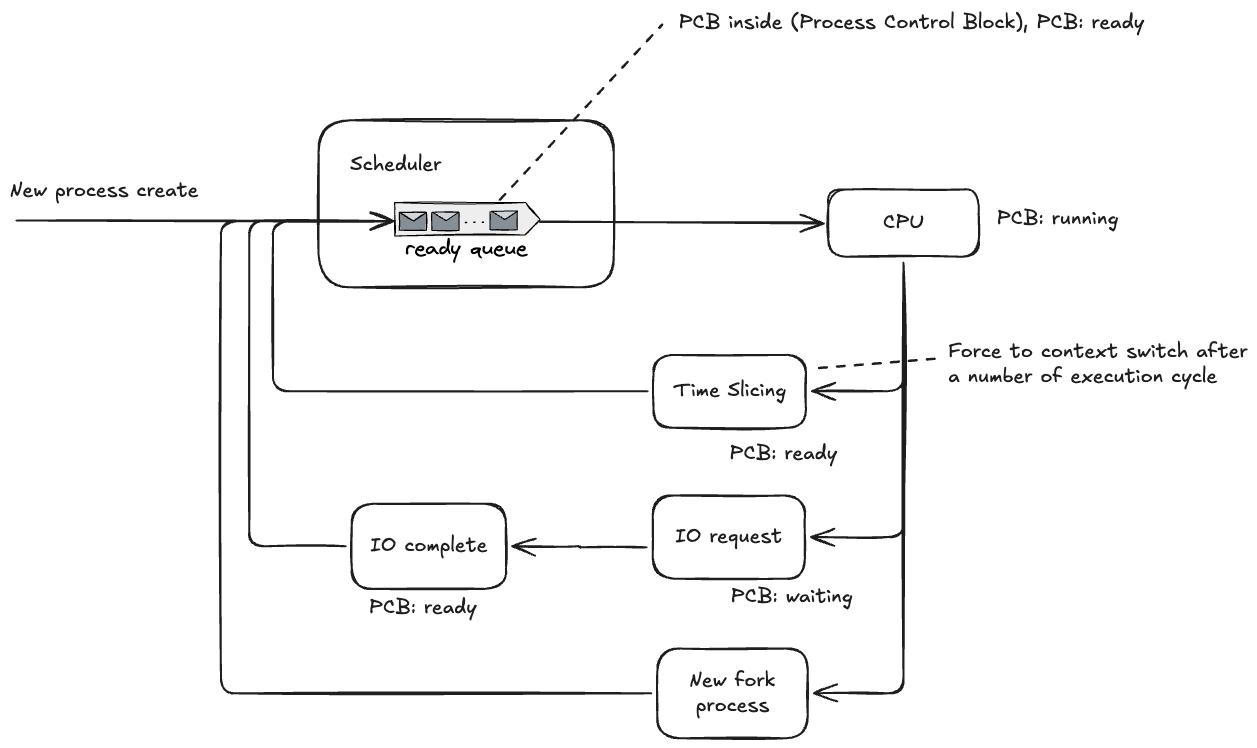
How multi-program running on single processor?
Scheduling Criteria
In the real world, no single scheduling algorithm fits all scenarios.
Different use cases optimize different criteria.
CPU utilization
We usually want to keep the CPU as busy as possible while doing useful work (often around 40% to 90%, depending on workload).
Throughput
The number of processes completed per time unit.
Waiting time
The total time a process spends in the ready queue.
Turnaround time
The total time from process submission to completion. (Ready queue + IO waiting + CPU execution)
Response time
How long it takes before a process gets its first CPU time, usually used for interactive systems. (First run start time - Arrival time)
Scheduling Algorithm
Non-preemptive scheduling: The running process cannot be switched out unless it blocks (for example, on IO) or terminates.
Preemptive scheduling: The running process can be switched out by time slicing or by the arrival of a higher-priority process.
FCFS
First-Come, First-Served belongs to non-preemptive scheduling. If a long CPU-bound process comes first, waiting time and response time can become poor (convoy effect). It is suitable for simple batch jobs.
SJF
Shortest Job First (SJF) is usually non-preemptive: the process with the shortest next CPU burst runs first. It generally gives better average waiting time because short (often IO-bound) jobs do not wait behind long CPU-bound jobs.
The preemptive version is Shortest Remaining Time First (SRTF).
Burst-time prediction: tau(n+1) = alpha * t(n) + (1 - alpha) * tau(n), where 0 <= alpha <= 1.
Round Robin
Round Robin applies time slicing. It is suitable for interactive systems because it usually provides good response time.
Priority Scheduling
Low-priority tasks have a risk of starvation. A common solution is aging.
Aging mechanism: If a process has waited too long, gradually increase its priority.
Multilevel Queue Scheduling
Separate tasks into multiple queues. Each queue can use a different scheduling algorithm.
Queues are assigned fixed priorities from high to low, and higher-priority queues are served first.
Multilevel Feedback Queue Scheduling
The problem with Multilevel Queue Scheduling is inflexible priority assignment. Tasks placed in low-priority queues may starve.Multilevel Feedback Queue Scheduling allows tasks to move between queues based on behavior and waiting time (for example, with aging), improving fairness.